
In brief
- Anthropic priced 980 million shares at $83, raising $81.34 billion—above SpaceX’s $75 billion initial offering but below its $86.25 billion expanded IPO.
- Google, Nvidia, and five other companies committed a separate $26 billion. Together with the new IPO shares, Anthropic expects $104.8 billion in net proceeds after fees.
- Behind the deal: explosive customer spending, $900.9 billion in infrastructure commitments and an OpenAI IPO potentially coming in 2027.
Anthropic has priced the largest initial IPO share sale in history at $81.34 billion, topping the $75 billion SpaceX first sold in June. But SpaceX still has the larger completed IPO after an additional share sale.
The Claude maker sold 980 million shares at $83 on Wednesday and is set to begin trading Thursday on Nasdaq under the ticker ANT.
The price beat the original $70-to-$78 range, while the company increased the offering from 825 million shares. Demand was about six times the number available before pricing.
At $83, Anthropic is valued at roughly $1.5 trillion including stock options and other potential shares, though its value based on outstanding shares is closer to $1.1 trillion.
Where the $107 billion goes
The headline $81.34 billion isn’t all money for Anthropic. About 956.35 million new shares bring $79.38 billion into the company before fees. Another 23.65 million shares, worth $1.96 billion, are being sold by its seven co-founders—roughly $280 million each. Anthropic receives none of that founders’ cash, according to its final prospectus.
On top of the public sale, seven technology companies are buying $26 billion of nonvoting stock in a separate private placement. Google and Nvidia are putting in $10 billion each, AMD $2.5 billion, Broadcom, Micron and Microsoft $1 billion each, and TSMC $500 million.
The public offering and private placement total $107.34 billion in gross share sales, including the $1.96 billion going to founders rather than Anthropic.
The $104.8 billion net figure is for both transactions, not for the IPO alone. Anthropic gets $79.38 billion from its newly issued public shares, plus $26 billion from the private placement: $105.38 billion before costs. Subtract roughly $580 million in company-paid underwriting fees and estimated offering expenses, and the prospectus estimates $104.8 billion net.
BitcoinBTC · USD
$63,067−12%
Nov 12Nov 14Nov 16Nov 17Nov 19
$71.9k$68.7k$65.5k$62.3k
24h HighHigh$64,006
24h LowLow$62,068
VolVol$1.1B
Market projectionsOdds by Myriad
 →

That said, it could rise to about $117 billion if underwriters buy all the extra shares allowed. Anthropic plans to spend the money on operations, hiring and, above all, computing infrastructure.
Goldman Sachs and Morgan Stanley led a 22-bank underwriting group, with roughly $550 million in underwriting commissions. The company also offered access through brokers including Fidelity, Schwab, Robinhood, and SoFi, but retail investors received less than 20% of the offering.
The winners—and who still controls Anthropic
Amazon remains the largest disclosed shareholder after the transaction with about 14.6% of the company, followed by Google at roughly 13.4%.
Early financial backers also hold enormous paper fortunes. Bloomberg estimates put Lightspeed’s stake near $28 billion, Iconiq’s above $26 billion and Menlo Ventures’ around $22 billion. Ashton Kutcher’s Sound Ventures reportedly holds shares worth almost $11 billion. Those figures are estimates of stock value, not cash they received at the IPO.
Investors, however, aren’t buying much control. A special share class gives the founders’ holding company 50.1% of shareholder voting power, while the Long-Term Benefit Trust can appoint a majority of the board.
So, Anthropic can raise historic sums while keeping key decisions largely away from ordinary shareholders.
The business growing almost too fast to measure
Anthropic generated $33.24 billion in revenue during the first nine months of 2026, including $16.96 billion in the third quarter alone—the latest reported quarter. Its $81 billion annualized revenue run rate at the end of October projects recent customer spending over a year; it isn’t money already earned.
Roughly 250 organizations now spend at least $10 million annually with Anthropic, and more than 1,900 spend at least $1 million, using trailing 12-month figures. Its net revenue retention reached about 900%.
In plain English, the same eligible customer group spent nine times as much in the latest three-month period as it did a year earlier. That measure excludes fixed-price Claude subscriptions.
But the business still depends on a few major accounts and distribution partners. Its five biggest customers generated about 25% of revenue over the first nine months of 2026, while cloud marketplaces accounted for 44%. In other words, companies like Amazon, Google and Microsoft can invest in Anthropic, provide the machines it runs on and help sell access to Claude.
Even the product changes at extraordinary speed: Claude models released during the six months through September made up more than 80% of third-quarter revenue. At the end of September 2026, Anthropic had about 5,300 employees and was generating more than $6.6 million in trailing annual revenue per employee.
An enormous business with an even bigger bill
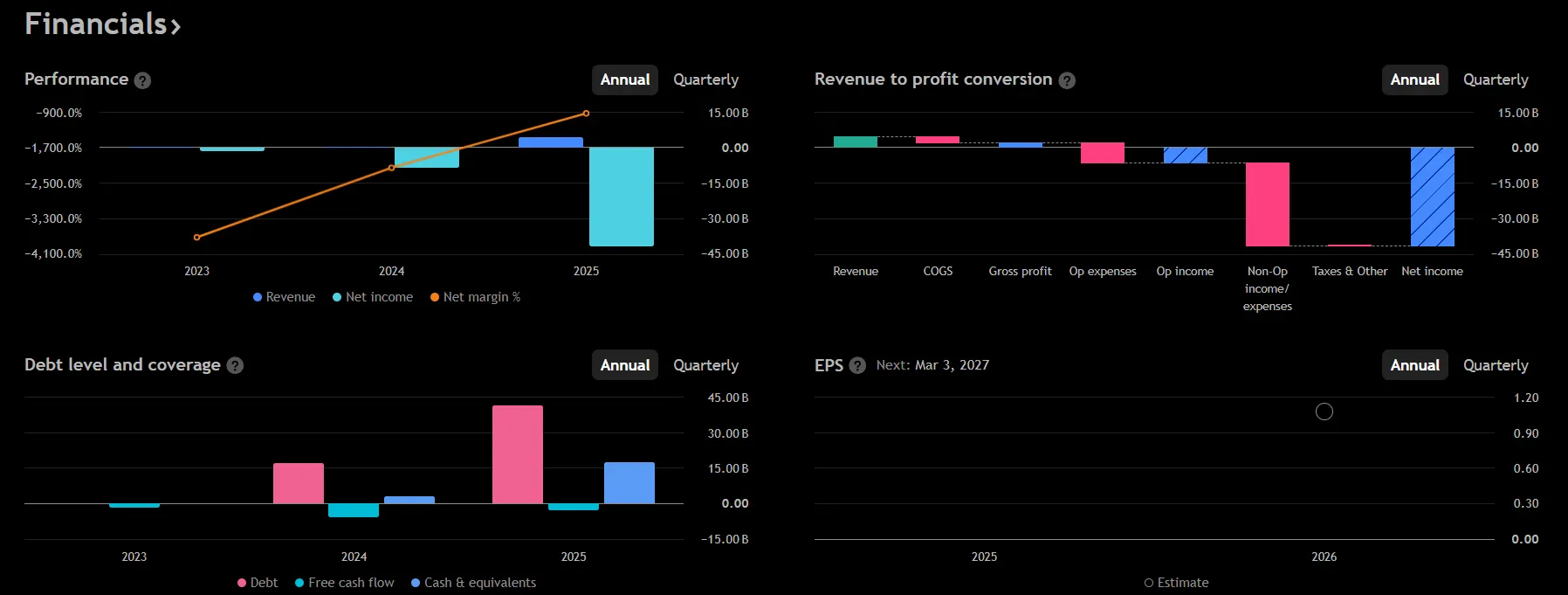
Rapid growth doesn’t mean easy profits. Anthropic posted a $567 million operating loss in the third quarter of 2026, after a $974 million operating profit in the second quarter. Over the first nine months, its operating loss totaled $1.26 billion. Those numbers tell a very different story from its much bigger headline net loss.
In the first nine months of 2026, Anthropic posted a $104.04 billion net loss, including $94.3 billion in noncash revaluations of convertible financing and related instruments. Yet it generated $6.57 billion in cash from operating activities during the same period. That is not free cash flow, which also accounts for capital spending, but the distinction matters: a $104 billion accounting loss does not mean $104 billion of cash burned.
The latest balance sheet, dated September 30, 2026, shows $95.6 billion in cash and equivalents plus $36.3 billion in short-term investments—$131.85 billion combined. Convertible notes payable stood at $130.50 billion at their accounting value, with some converting into shares around the IPO.
The final prospectus estimates $232.35 billion in cash and short-term investments on a pro forma, post-transaction basis. That last figure is a modeled balance after the offering and related adjustments, not cash the company held on September 30.
The more consequential number may be what it has promised to spend next. Anthropic disclosed about $900.9 billion in commitments, overwhelmingly for computing and infrastructure, stretching as far as 2045.
It separately estimates another $150 billion to $175 billion in payments under arrangements without fixed dollar amounts. Together, that points to potentially more than $1 trillion—but it is not a bill due today, and some contracts are conditional or can be terminated.
Some $70.7 billion of the stated commitments fall due in the 12 months after September 2026. That explains why even an IPO this large is not necessarily excessive capital for a frontier AI company. Every breakthrough attracts customers, but serving them requires more chips, power, and data centers.
What the SpaceX record means for OpenAI
There is a technical catch to the record. SpaceX’s June IPO initially sold $75 billion in shares, but the final deal reached $86.25 billion gross after underwriters bought more shares—about $85.675 billion after fees, according to SpaceX’s SEC filing.
Anthropic’s $81.34 billion beats SpaceX’s initial deal, not its final gross total. The extra $26 billion from Anthropic’s private placement cannot be counted as public IPO proceeds. Its own option covers another 147 million shares worth about $12.2 billion; if exercised in full, its public IPO would reach $93.54 billion, comfortably above SpaceX’s final figure.
Now attention turns to OpenAI. The ChatGPT maker recently raised $11 billion at a reported $1.25 trillion valuation and has indicated it will not list before 2027. Anthropic’s debut offers a public-market test of what investors are willing to pay for AI revenue, while exposing the cost of generating it.
The interesting part isn’t just that a five-year-old AI lab topped SpaceX’s initial IPO. It’s that it assembled more than $100 billion in combined public and private financing, started generating cash from operations—and still faces a potential trillion-dollar computing bill.
Daily Debrief Newsletter
Start every day with the top news stories right now, plus original features, a podcast, videos and more.
Join 72,000+ readers


